
What Democracy Looks Like From the Inside
The Akron Civic Assembly on Housing: Sessions to Date
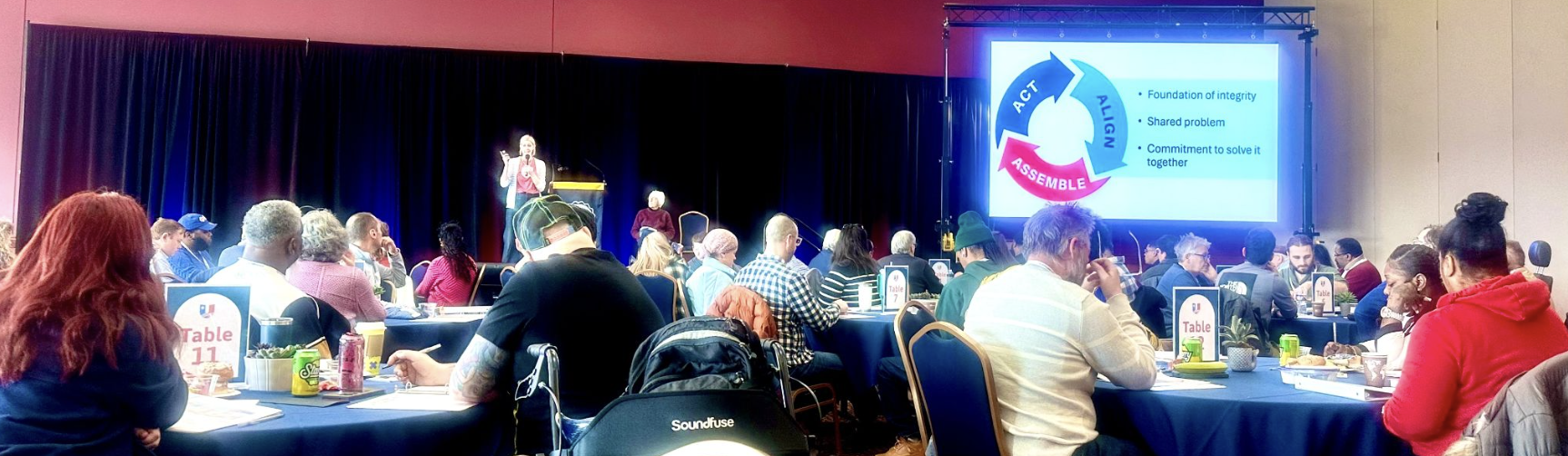
It's a Saturday morning in Akron. You're in a room with 64 strangers, and seated at a table with 5 of them. The person next to you grew up in a different neighborhood, votes differently, and has experiences with housing that are nothing like yours. For the next several hours, together, your small group will try to figure out something genuinely hard.
A facilitator makes sure everyone at your table gets a turn to share their perspective. The question in front of you isn't hypothetical. Tt's a real proposal, one that could end up in front of City Council, and that could change how housing works in this city.
This is what the Akron Civic Assembly on Housing looks like from the inside. And it has been happening, session by session, since March 14.
But First, Learning
Before the 65 Delegates could deliberate, they had to understand–not just the ins and outs of housing in Akron, but also how this process was going to go. And so the first full session, held on March 14, was an orientation.
That Saturday, the Delegates met each other for the first time. Sixty-five people from across Akron doing speed introductions, building early connections across neighborhoods and sharing experiences they might never otherwise have shared. They learned the skills of deliberation: what it means to listen actively, to recognize their own biases, to make a clear case without talking over someone else. And they took their first honest look at Akron's housing landscape: the vacancy rates, the code violations, the affordability gaps, the patterns that have built up over decades.
They also submitted questions. Hundreds of them. These questions were delivered to the Akron Civic Assembly’s Research and Solutions Teams, people working to make sure the proposals in front of Delegates were grounded in real data.
Twelve Proposals
The Assembly isn't deliberating in the abstract. Over 165 community-generated ideas were gathered, reviewed, and narrowed by the Solutions Team. That team is made up of people from housing organizations across Akron, who whittled the 165 ideas into 12 concrete proposals that genuinely needed public deliberation.
Together, those proposals support three overarching outcomes that guide the Delegates’ work:
Safe and quality housing — addressing blight, absentee landlords, and code enforcement gaps.
More housing for all — increasing density, affordability, and access.
Funding solutions — identifying sustainable ways to finance housing improvements over the long term.
These aren't soft goals. The proposals that fall under these three outcomes include a dedicated housing docket in the courts, civil housing citations for property violations, reclassifying how criminal history can be used in housing decisions, a public database of code violations, and more.
Real ideas, with real tradeoffs, debated by real residents. See the Assembly briefings here.
The Work Gets Harder And the Room Rises to It
After the first deliberation session, the facilitators debriefed. They concurred: the Delegates hadn’t been given enough time during their Saturday session to meaningfully engage with the content. And so the agenda for the next session was adjusted. The structure was refined so that Delegates could go deep on each idea, not just skim across the surface.
Session 3 brought some of the Assembly's thorniest proposals to the table: issuing civil citations for housing violations, treating criminal history as a protected class, and creating a public database of code violations. All three touch on questions of accountability, fairness, and power — between landlords and tenants, between residents and institutions, between what's legal and what's just.
After the session, the Delegates filled out their feedback surveys.
On a scale of 1 to 5, they rated their session experience. Here's what they said:
"My facilitator made sure everyone at my table had a chance to participate." — 4.94
"Discussions at my table were respectful, even when people disagreed." — 4.91
"Listening to others helped me think about the issues in a new way." — 4.85
"I felt comfortable sharing my honest views at my table." — 4.77
"The information I received helped me understand the ideas without pushing me toward a particular view." — 4.66
And keep in mind, this overwhelmingly positive feedback followed hours of difficult conversations about contested, high-stakes proposals. With strangers from across the city.
What Does Democracy Sound Like
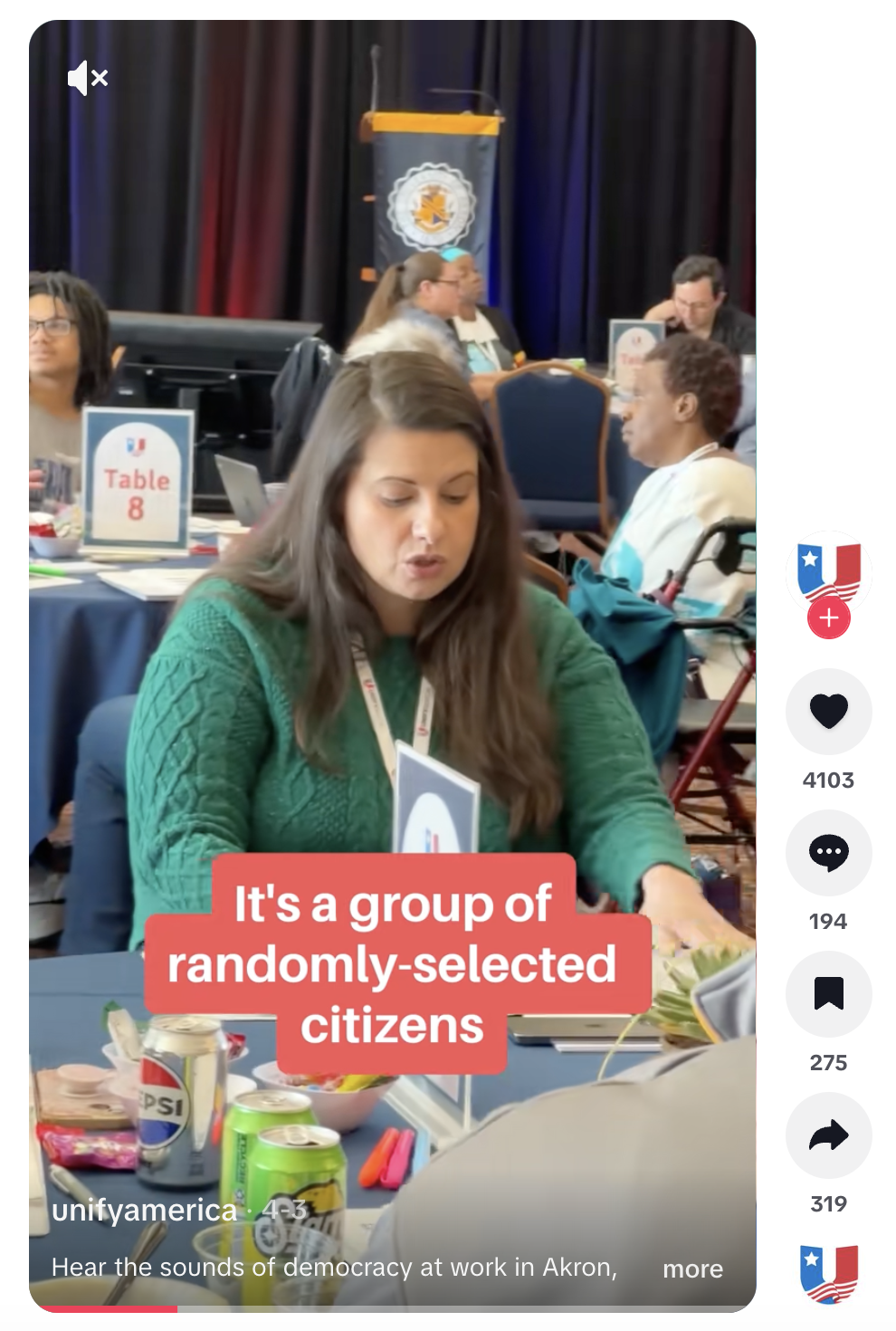
Unify America’s Founder Harry Gottlieb captured a moment from inside the Civic Assembly that ended up being the team's most-watched piece of content ever. Watch it here.
What Comes Next
The Civic Assembly is in its final stretch. Delegates have been meeting for weeks, building toward two moments that cap everything they've done:
On May 9th, the Assembly opens its doors. Observers are welcome to come and watch the deliberation process live, and join Delegates for lunch.
On May 21st, the Delegates present their final recommendations. After ten weeks of learning, deliberating, and working toward two-thirds consensus on some of the hardest questions in housing policy, Akron will hear what its residents have decided.
Mayor Malik and Akron’s City Council have already committed to respond — publicly, formally — to every recommendation.
The bet that underlies all of this, that ordinary people, given real information and genuine respect, can make wise decisions about hard problems, is about to be tested.
From everything we've seen so far, Akron is ready.
